Preliminary Dance Assessment: Part A.
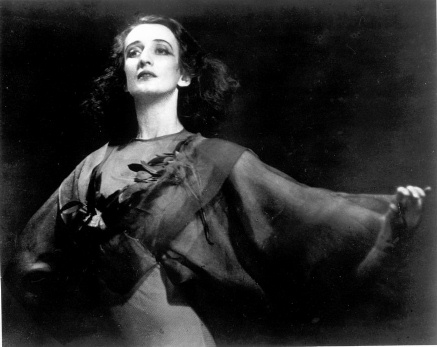
Doris Humphrey.
“The Dancer believes that his art has something to say which cannot be expressed in words or in any other way than by dancing.” - Doris Humphrey
Background and Dance Training.
Doris Humphrey
was born on October 17th 1895 in
Doris’ mother put her into ballet classes as a young child and her schooling began at the Francis Parker School in Chicago founded on John Dewey’s principles of progressive and experimental learning, a philosophy which remained with Doris throughout her life.
To help her mother financially, Doris opened her own dance school at the age of 18.
It was at the
Denishaw school in Los Angles were her teaching and choreographic aptitudes
became known. In 1928 Doris left the Denishaw school and formed the
Humphrey-Weidman Company with Charles Weidman located in
In 1959 Doris published a book regarding her theories of dance composition which was titled ‘The Art of Making Dances’.
Doris Humphrey was inspired by a range of sources such as nature ,architecture, Freudian psychology and German philosophers, but her main inspiration was her school teacher Mary Wood Hinman who taught dance at the Francis Parker School. Mary Wood Hinman encouraged Doris to take the Summer course at Denishaw school in Los Angles. This was where her talents were recognized.
The German philosopher Friedrich Nietzsche and his book ‘The Birth of Tragedy’ was where Doris’s fall and recovery technique was inspired.
In regards to Freudian psychology Doris was inspired by the divided human awareness between the balanced, intellectual side and the disorganized, emotional side.
Doris Humphrey also drew inspiration from architecture, in particular the works of Frank Lloyd Wright.
Doris Humphrey is known for the development of her own technique known as ‘fall and recovery’. This technique was very modern for its time and is still present in the study of movement as well as within dance today.
This technique and philosophy went against the traditions of ballet. Ballet emphasizes movements that defy gravity while Humphrey’s fall and recovery technique relies on gravity to achieve the proper movement required.
Doris also had a unique method of teaching. She discovered the difference between instructions and education. Doris Humphrey allowed her students to develop their own individuality and creativity.
Humphrey characterized her movement patterns as: accent, flow, opposition, rest, succession, sustained, sharp, and unison.
The ‘Doris Humphrey Society’ is an organization, established in 1989. The organization informs of Doris Humphrey’s life and her choreography. It shared multiple educational programs such as dance workshops, seminars and performances. The society also plans to restructure Humphrey’s choreography, keeping role in the development of dance alive today in our modern world.
Colour Harmony 1928: This was Doris Humphrey’s first independent work.
Air for the G String 1928: Choreographed in 1934, this was one of Humphrey’s earlier works beginning her choreographic style.
New Dance Trilogy: Three works that were separately performed but joined by the selection of the music and the theme. This consisted of New Dance (1935), With My Red Fires (1936) and Theatre Piece (1936).
Water Study1928: This piece exemplifies Humphrey’s fall and recovery technique and was inspired by natural breathing.
Humphrey’s fall and recovery technique was the basis of her teaching methods and is created from the idea of the pull between stability and imbalance. Doris relies on gravity to achieve her style and technique, unlike the conventions of ballet which aim to resist gravity in their movements. She was intrigued by the peak of range in the suspension of tension. Her work and technique required the dancers to make movements that put themselves off balance then use the resulting momentum to regain control.
Doris Humphrey played a significant role in the development of modern dance, making a multiple number of contributions to dance, particularly her fall and recovery technique. Doris focused on dance composition for groups of dancers rather than soloists which was also different for her time period.
She also challenged the relationship between dance and music believing that emotions determined movements, stating that her dances were created “from the inside out”. Doris’s original teaching methods have also contributed to modern dance, allowing the students to expand their own individual style.
